You know your open chords and your barre chords. You can play a pentatonic solo and a good number of songs. And yet, if you’re honest, you play about the same as you did a year ago. Welcome to the intermediate plateau. Almost every guitarist hits it, and it’s not a sign you’ve reached your limit.
The plateau usually has one cause: you’ve become very good at practising what you already know. Here are nine ways to break out of it.
1. Find out what you actually can’t do
Record yourself playing a song you think you know well, with a metronome or a backing track. Listen back critically. Are your chord changes late? Do bends go out of tune? Does your timing rush in the fast bits? That list is your new practice plan. Most players skip this step and keep practising their strengths.
2. Slow everything down
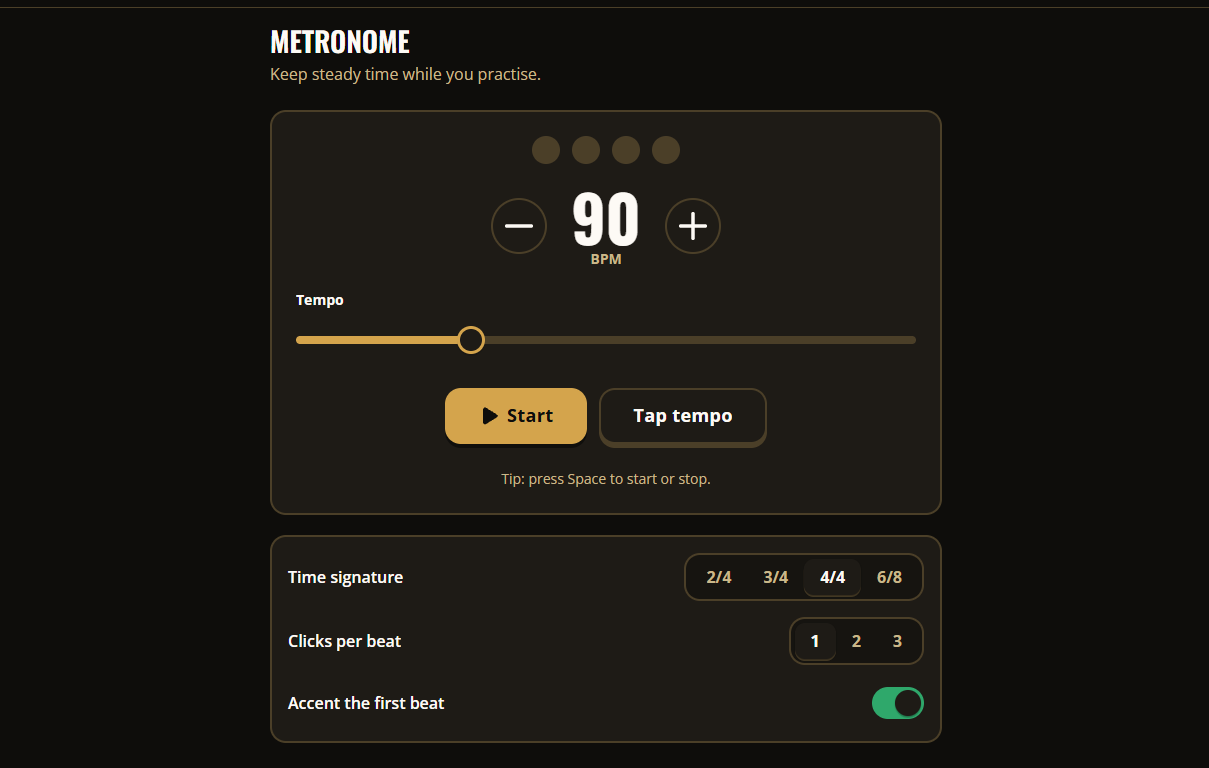
Intermediate players hate slowing down, because it feels like going backwards. But playing something you “know” at half speed reveals every tiny hesitation, every sloppy note and every bit of tension in your hands. Fix it slowly, then speed it up 5 BPM at a time with a metronome. Speed is a result of accuracy, not effort.
3. Get out of the pentatonic box
If every solo you play starts in the same pentatonic shape at the same fret, you’re not alone. Two ways out:
- Connect the five shapes. Learn all five pentatonic positions and practise sliding between them, so the whole neck becomes one map instead of five boxes.
- Add notes. Add the 2nd and 6th to minor pentatonic and you get the Dorian sound; add the 4th and 7th to major pentatonic and you get the full major scale. A few extra notes change your sound completely.
4. Learn the notes on the neck
Shapes will only take you so far. When you know where every C, every E and every G is, you can find any chord, scale or arpeggio anywhere. Start with the notes on the low E and A strings, then use octave shapes to find them on the other strings. Five minutes a day is enough.
5. Play chord tones, not just scales
Great solos follow the chords. Learn the three notes of each chord (the triad) and target them when the chord changes. Try playing a solo over a simple progression using only the notes of the current chord. It’s hard, it sounds amazing, and it’s the single biggest step from “running scales” to “playing melodies”. My chord library shows the notes in every chord.
6. Learn some theory you can use
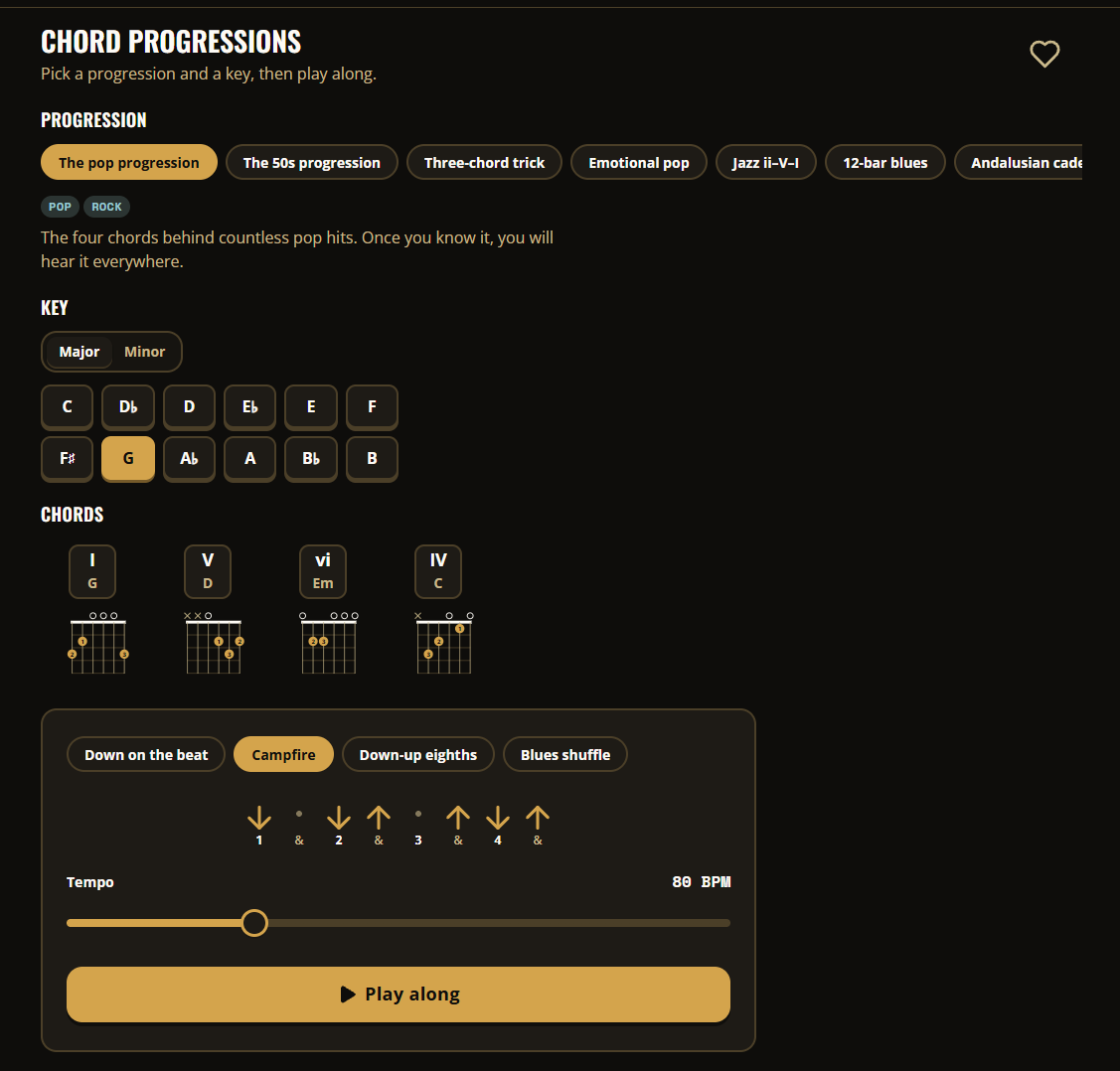
You don’t need a degree, but knowing how keys work makes everything faster. Why do G, C, D and Em sound good together? Which chords belong to the key of A? The circle of fifths answers these questions in one picture, and helps you work out songs, transpose and write your own progressions.
7. Work on your rhythm playing
Most intermediate players spend 90% of their practice on lead guitar, but most of the time in a band you’re playing rhythm. Work on tight, consistent strumming, muting, accents and dynamics. Play along with drum loops. Learn a funk rhythm part. A guitarist with great time always sounds good, even playing simple chords.
8. Learn from other styles
If you play rock, learn a blues shuffle, a bossa nova pattern or a fingerstyle folk song. If you play acoustic, try some funk or a metal riff with palm muting. Every style brings techniques and ideas you’d never discover in your usual music. Transcribing a solo by ear, even just a few bars, trains your ears faster than any app.
9. Make music, not just practice
Write a song. Start a duo. Join a jam night. Play for friends. Having a real goal, like a gig, a recording or a jam next Thursday, gives your practice purpose and puts healthy pressure on you. Most players improve faster in the four weeks before a gig than in the six months before it.
Your plateau-breaking week
Here’s what a week could look like if you put the above into practice, in about 45 minutes a day:
- Daily (10 min): warm-up plus notes on the neck
- Monday and Thursday (20 min): connecting pentatonic shapes and targeting chord tones over a backing track
- Tuesday and Friday (20 min): rhythm: strumming patterns, muting and playing along with drums
- Wednesday (20 min): transcribe a few bars of a solo or riff by ear
- Weekend: record yourself, listen back, and set next week’s focus
- Every day (15 min): play real music: songs, jams, writing
For a full structure for each session, see how to build a guitar practice routine that works.
One more thing: check your guitar
Sometimes the plateau is partly mechanical. High action, worn frets or bad intonation make bends harder, chords sound out of tune high up the neck, and fast playing feel like hard work. If your guitar hasn’t had a setup in a year or two, it’s worth checking. Book a guitar setup and I’ll make sure your guitar isn’t holding you back.