Neural DSP Quad Cortex Mini Review (2026): Full Power, Half the Size
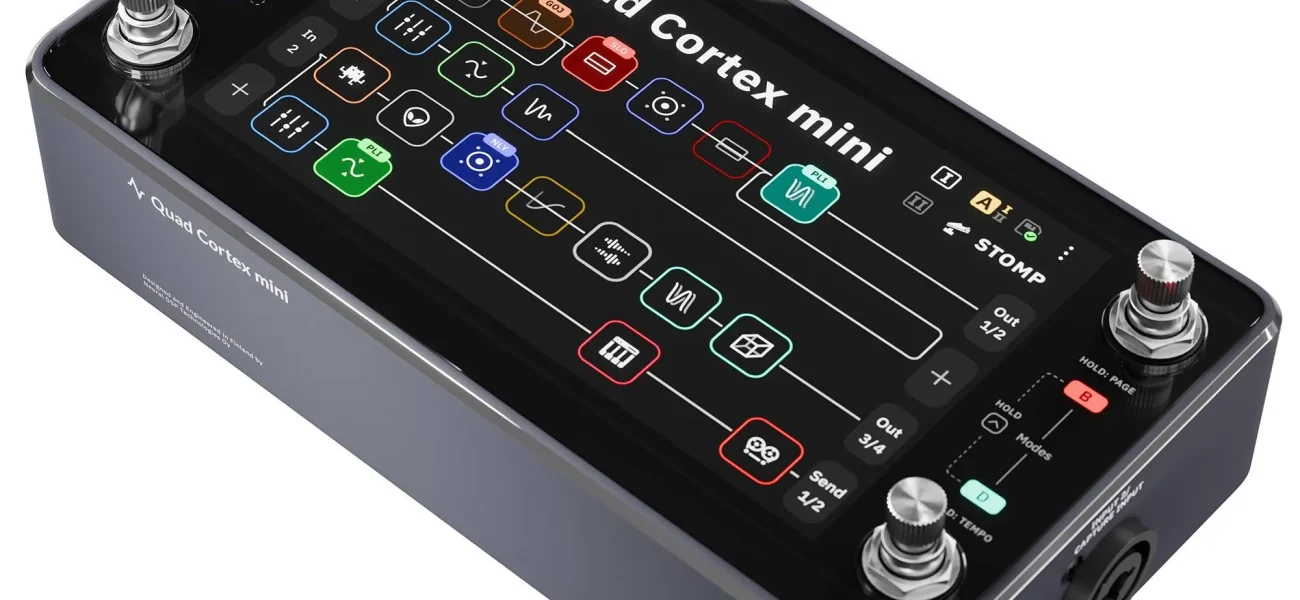
When Neural DSP took the stage at NAMM 2026 with the Quad Cortex Mini, the guitar internet immediately exploded. For years, players had been asking for a smaller, more pedalboard-friendly version of the flagship Quad Cortex that still kept the iconic 7-inch touchscreen and full processing power. This is that pedal. But does it actually deliver? And is it worth €1,299?
In this hands-on review, we break down everything you need to know: design, specs, sound quality, Neural Capture, usability, and how it stacks up against the full-size Quad Cortex and the Nano Cortex. Whether you are a touring musician, a home studio player, or just deep in a rabbit hole of amp modeler research, this guide is for you.
Overview: What Is the Neural DSP Quad Cortex Mini?
The Neural DSP Quad Cortex Mini is an ultra-compact amp modeler and multi-effects processor for guitar and bass. Announced at the NAMM Show in January 2026, it was described by Neural DSP as delivering “no compromise, just smaller” — the complete Quad Cortex experience packed into a body that is over 50% smaller than the original.
Neural DSP has been one of the dominant forces in the amp modeler space since the Quad Cortex launched in 2020 and changed the game for how guitarists approach live performance and studio recording. Since then, the Helsinki-based company has faced strong competition from Line 6’s Helix range, Fractal Audio, IK Multimedia, and others, but its combination of intuitive UI and industry-leading modeling has kept it at the top of the conversation.
The Quad Cortex Mini sits between the full-size Quad Cortex and the smaller Nano Cortex in the Neural DSP lineup. It runs the same CorOS software, shares the same processing hardware, and even carries over that famous 7-inch multitouch display — which is the most striking visual feature of the unit. If you have been eyeing up the flagship but found it too big for your board or your budget — well, mostly the size — this is Neural DSP’s answer.
Price: €1,299
Full Specs at a Glance
| Spec | Detail |
|---|---|
| Dimensions | 22.8 x 11.8 x 6.5 cm (8.9″ x 4.6″ x 2.5″) |
| Weight | 1.5 kg (3.3 lbs) |
| Display | 7″ multitouch capacitive touchscreen |
| Footswitches | 4 stainless steel rotary footswitch encoders |
| Amp Models | 90+ |
| Effects | 100+ |
| Cabinet IRs | 1,000+ |
| Factory Neural Captures | 2,000+ |
| Neural Capture | V1 (on-device) and V2 (cloud-processed) |
| USB Audio | 16-channel USB-C (8 in / 8 out) |
| Inputs | 1/4″ TS instrument + XLR/TRS combo (with phantom power) |
| Outputs | 2x XLR balanced + 2x 1/4″ TRS |
| FX Loops | Dual (combined via TRS) |
| MIDI | 3.5mm TRS MIDI in and out/thru |
| Headphone Out | 3.5mm |
| Wireless | Built-in Wi-Fi |
| Power | 12V DC (included) or USB-C |
| Software | CorOS (same as full Quad Cortex) |
| Price | €1,299 |
Design and Build Quality
The first thing anyone notices about the Quad Cortex Mini is the glass. The entire top surface of the pedal is dominated by the 7-inch touchscreen — it is essentially a screen with four corner footswitches, housed in an anodized aluminum unibody enclosure. It looks unlike anything else on the market, and it is undeniably striking.
Understandably, the glass top has made a lot of guitarists nervous. Stomp switches and glass do not traditionally go together. However, Neural DSP has stressed that extensive durability testing was carried out before launch, and reviewers who have put the Mini through its paces in real-world conditions — including hard stomps in boots — report that the unit holds up extremely well. Neural DSP brand ambassador John Connearn noted at NAMM that the company tested every possible parameter to ensure the unit was, in his words, “borderline unbreakable.” Even the YouTuber Ola Englund reportedly used his unit as a trampoline without incident.
The aluminum unibody is solid and reassuring. At 1.5 kg, it is heavier than it looks but absolutely manageable on a pedalboard or desktop. The locking power connector is a thoughtful addition for live use. Four stainless steel rotary footswitch encoders sit in the corners of the unit; they twist and stomp, serving as both footswitches and parameter knobs, which is central to how the Mini operates.
One note: the unit is flat rather than angled like the full Quad Cortex. This means reaching the top footswitches requires a slight arch, which some players find less natural. It is not a dealbreaker, but worth knowing before you buy.
Sound Quality and Amp Modeling
This is where the Quad Cortex Mini really earns its price tag. The amp modeling is world-class. With over 90 amp models ranging from clean Fender-style tones to crunchy Marshall-inspired crunch to high-gain EVH-style lead tones, the breadth of coverage is impressive. More importantly, the models respond dynamically to your playing — rolling back the volume knob cleans up the tone just like a real amp would, and switching pickups produces the expected tonal changes.
Reviewers across the board — from Sweetwater to MusicRadar to Guitar World — have noted that the Mini is sonically indistinguishable from the full-size Quad Cortex when both are run at matched output levels. That is the most important benchmark there is, and the Mini passes it.
The effects library is equally strong. Modulation, delay, and reverb effects are detailed and musical. The Micro Processor effect, for instance, has been praised by digital effects enthusiasts as comparing favorably to classic algorithms found on dedicated boutique effects units. Drive models are good overall, though some reviewers have noted that overdrive and fuzz emulations are a slight step behind the rest of the library — a minor caveat on an otherwise excellent platform.
For bass players: the Mini handles bass just as well as guitar, making it a genuinely versatile all-in-one rig for players who switch between instruments.
Neural Capture V1 and V2
Neural Capture is the technology that has set Neural DSP apart from the competition since 2020. It uses a neural network algorithm to digitize the sonic characteristics of any physical amp, cabinet, or drive pedal with high accuracy — capturing not just the tone but the dynamic feel and response of the gear.
The Quad Cortex Mini supports both capture versions:
- Neural Capture V1 runs entirely on the device, offline, with no internet connection required. It is fast and accurate for most amps, cabinets, and overdrive pedals. Ideal for everyday use and straightforward capture tasks.
- Neural Capture V2 processes via Cortex Cloud using a higher-resolution algorithm. It takes longer but delivers significantly more accuracy for complex, touch-sensitive gear like fuzz pedals, compressors, and highly dynamic tube amps. V2 captures subtle amp behaviors like sag, bloom, volume-knob cleanup, and fast transients that V1 can miss.
In hands-on testing (Sweetwater), a Blackstar HT40 was captured using both methods. V1 delivered results comparable to a high-quality amp sim. V2, however, was described as “downright uncanny” — the reviewer reported being genuinely unable to tell the difference between the digital capture and the real amplifier, either by ear or by touch response.
The Mini also comes preloaded with over 2,000 factory Neural Captures, and free access to thousands more via the Cortex Cloud community library. If you do not own an amp worth capturing, there is still a huge palette of tones available from day one.
Usability and Interface
The Quad Cortex Mini runs the full CorOS software, the same operating system found on the flagship. This means the Grid view — the visual, drag-and-drop signal chain editor — is present and fully functional. You can build complex parallel signal paths, place blocks freely, and adjust every parameter either by touch or via the rotary footswitches.
With only four footswitches instead of the original’s eleven, Neural DSP has had to be creative. The solution is a multi-mode approach: Preset mode for switching complete rigs, Scene mode for seamless changes within a preset, Stomp mode for a traditional pedalboard-style layout, and Hybrid mode for combining control styles across the four switches. There is also a Gig View for a clean, stage-focused display during performance.
Neural DSP has also introduced a new parameter-editing approach using the rotary footswitches — an “Etch-a-Sketch” style navigation that lets you cycle through parameters and adjust them on the fly with your feet. Reviewers from Guitar World have highlighted this as a genuinely useful innovation that they would like to see introduced on the full-size QC.
The honest caveat: four footswitches do require more tapping and mode-switching than eleven. If you rely heavily on real-time footswitch access to individual stomps during a set, the workflow difference between the Mini and the full QC is meaningful. For most gigging players this is manageable, but it is worth considering your live performance workflow before committing.
Presets and full backups transfer seamlessly between the Mini and the full Quad Cortex — nothing to rebuild, no compatibility issues. If you already use a full QC, you can drop right into the Mini with your existing sounds.
I/O and Connectivity
For a unit this compact, the I/O is genuinely impressive:
- Input 1: 1/4″ TS instrument input
- Input 2 / Capture Input: XLR + 1/4″ TRS combo with phantom power (for microphones as well as instruments)
- Dual FX Loops: Shared 1/4″ TRS — use a standard TRS cable for one loop, or a TRS insert (TRS to dual TS) to access both simultaneously
- Expression Pedal Input: 1/4″ TRS (a second expression input is available via MIDI)
- XLR Outputs: Two balanced mono XLR outs for direct-to-PA or interface use
- 1/4″ Outputs: Two additional TS outputs for amp use or flexible routing
- MIDI: 3.5mm TRS in and out/thru (Type-A)
- USB-C: 16-channel audio interface (8 in / 8 out) and firmware/data management
- Headphone Out: 3.5mm for silent practice or monitoring
- Wi-Fi: Built-in for Cortex Cloud access and firmware updates
The main trade-offs versus the full Quad Cortex: the dual FX loops are now combined into a single TRS jack (requiring an insert cable to use both), full-size MIDI ports are replaced by 3.5mm TRS, and there is one fewer combo input. For most players, these are minor compromises. For players with complex MIDI rigs or multiple external effects units, it is worth factoring in.
Quad Cortex Mini vs Full Quad Cortex
This is the key question for most buyers. Here is an honest comparison:
| Feature | Quad Cortex Mini | Quad Cortex (Full) |
|---|---|---|
| Processing Power | Identical | Identical |
| Sound Quality | Identical | Identical |
| 7″ Touchscreen | Yes | Yes |
| Footswitches | 4 | 11 |
| Combo Inputs | 1 (+ 1x 1/4″ TS) | 2 combo |
| Dual FX Loops | Combined TRS | Separate jacks |
| MIDI Ports | 3.5mm TRS | Full-size DIN |
| Size | 50%+ smaller | Full-size floorboard |
| Weight | 1.5 kg | 4.4 kg |
| Price (approx.) | €1,299 | €1,599+ |
If you are a gigging guitarist who relies on many live footswitch changes and has a complex external MIDI rig, the full QC remains the most practical option on stage. As a studio tool, desktop unit, or compact fly rig, the Mini is arguably better — its small footprint, USB-C interface functionality, and desktop-friendly design make it near unbeatable for the recording guitarist.
Quad Cortex Mini vs Nano Cortex
These two should not really be compared — they are very different products. The Nano Cortex (launched in 2024, around €500) is a compact, screen-less pedal focused on Neural Capture playback with a simplified effects chain. It is aimed at players who want a portable, pedalboard-friendly tone source using their existing captures.
The Quad Cortex Mini is a full-featured multi-effects processor with a touchscreen, amp modeling, the complete effects library, dual signal paths, and the full CorOS workflow. It is a different product at a very different price point. If you want a small standalone pedal for captures, the Nano Cortex still has a place. If you want everything the Quad Cortex does, just smaller, the Mini is the answer.
Pros and Cons
Pros
- Identical processing power and sound quality to the full Quad Cortex
- Same 7-inch multitouch display in a dramatically smaller body
- Full Neural Capture V1 and V2 support
- Outstanding amp modeling across clean, crunch, and high-gain tones
- Excellent effects library — modulation, delay, and reverb especially
- 16-channel USB-C audio interface built in
- Full CorOS software with Grid view, Scenes, Stomp mode, and Gig View
- Preset and backup compatibility with full Quad Cortex
- Robust anodized aluminum build with locking power connector
- Cortex Cloud integration for thousands of community captures
- Wi-Fi for wireless updates and cloud access
- More affordable than the full Quad Cortex
Cons
- Only four footswitches — more mode-switching required for live use
- Glass top surface will concern some players (though proven durable in testing)
- Dual FX loops share a single TRS jack (requires insert cable for both)
- MIDI is 3.5mm TRS only — no full-size DIN ports
- Drive pedal models slightly behind the rest of the effects library
- Flat body (not angled) — top footswitches require a slight reach
- App-based signal chain editing not yet available (unlike Nano Cortex)
- €1,299 is a significant investment for a compact unit
Verdict: Should You Buy the Neural DSP Quad Cortex Mini?
The Neural DSP Quad Cortex Mini is one of the most impressive pieces of guitar gear released in 2026. Neural DSP’s engineering team has done something genuinely difficult: they have taken a flagship product with a large, feature-rich form factor and compressed it into a compact unit without any meaningful compromise in sound or processing power. The tones are identical to the full Quad Cortex, the 7-inch touchscreen is there, Neural Capture V1 and V2 are both present, and the CorOS workflow carries over completely.
Who is it for? If you want the full Quad Cortex experience but your pedalboard, studio desk, fly rig, or travel bag does not have room for the full unit, the Mini is a compelling answer. It is particularly strong as a studio and recording tool — the compact footprint, USB-C interface, and desktop-friendly design make it exceptional in that context. For live gigging, players who need many footswitch changes in real time will need to adapt their workflow, but for most performing guitarists, the four multi-function footswitches are workable.
At €1,299, it is not cheap. But when you consider what you are getting — full flagship processing power, world-class amp modeling, the complete effects library, Neural Capture, a built-in audio interface, and the best touchscreen UI in the modeler market — the value proposition holds up well. The glass screen and reduced footswitch count are the only genuine trade-offs, and neither is a dealbreaker.
Our rating: 4.5 / 5
The Quad Cortex Mini is exactly what thousands of guitarists asked for. Neural DSP has delivered it without cutting corners. If the full Quad Cortex ever tempted you but the size put you off, this is the one.
Where to Buy the Neural DSP Quad Cortex Mini in the Netherlands
The Neural DSP Quad Cortex Mini is available online via Thomann and other major EU retailers. Demand has been very high since launch — if you see it in stock, do not wait around. Current price: €1,299.
Shop guitar products