If you’ve been shopping for a multi-effects pedal without wanting to spend a lot of money, chances are the NUX MG-300 has come across your radar. It’s compact, it’s affordable, and on paper it punches well above its price tag. But does it hold up in practice? I spent time putting it through its paces, bedroom noodling, recording sessions, and live use, and here’s the full picture.
First Impressions: Build & Design
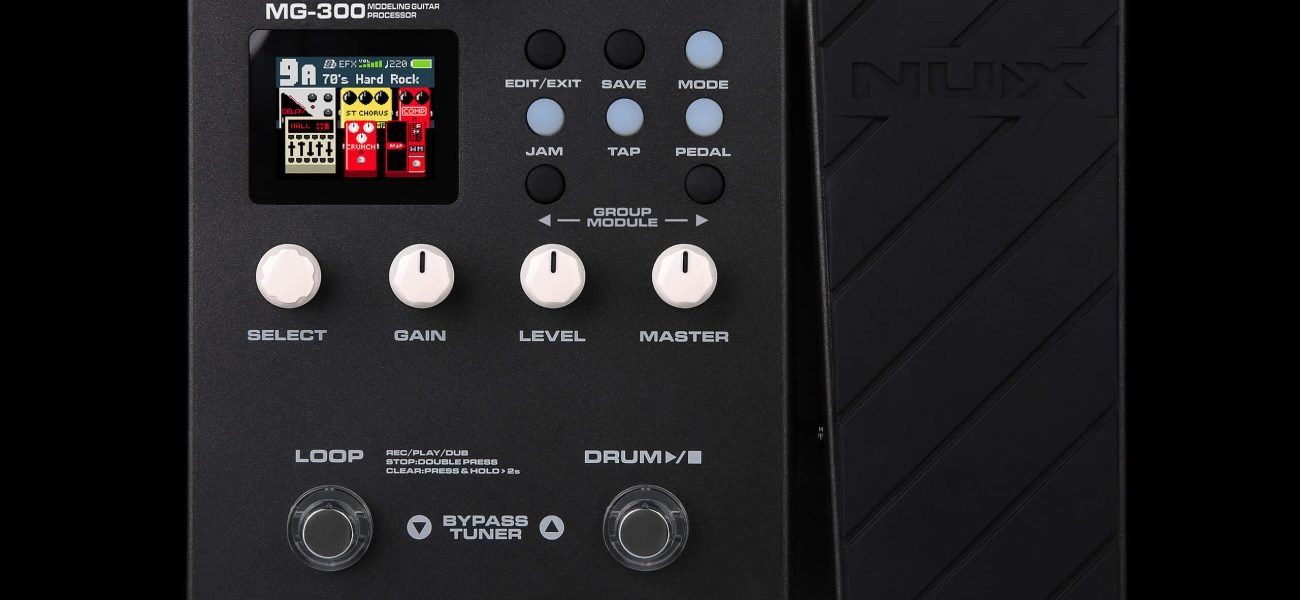
The MG-300 arrives in a no-nonsense compact metal chassis that feels genuinely sturdy. It’s small enough to live on a pedalboard without hogging real estate, but solid enough that you’re not worried about it rattling apart after a few gigs. The layout is sensible: a clear LCD screen dominates the upper section, with a row of knobs and dedicated mode buttons sitting below it, and three chunky footswitches taking up the lower half.
The footswitches have a satisfying click to them – not spongy, not hair-trigger. The knobs turn smoothly with just the right amount of resistance. For the price, the hardware quality is genuinely impressive. One detail worth noting: the screen is large and easy to read, even on a dim stage. That’s not something you can take for granted at this price point.
Under the Hood: TSAC-HD Technology
Here’s where things get interesting, and where NUX separates the MG-300 from a lot of its budget competitors.
Most digital multi-effects at this price point use a linear algorithm for amp and overdrive modeling. The problem with linear systems is that parameters behave independently – tweak the gain, and only the gain changes. Real tube amplifiers don’t work that way. In an actual analog circuit, adjusting one control affects the entire signal path in subtle, interactive ways. That’s a big part of what makes tube amps feel alive and responsive.
NUX’s answer to this is TSAC-HD (True Simulation of Analog Circuit, High Definition). Rather than a simple linear model, it uses a white-box algorithm that replicates real negative-feedback behavior – the way parameters interact and affect each other just like in genuine analog circuitry. In practice, this translates to amp models that respond to your playing dynamics in a way that feels more natural than you’d expect at this price. Back off the guitar volume and the overdrive cleans up. Dig in harder and things break up more aggressively. It doesn’t feel like a flat, static sound – it breathes.
Amp Models & Pre-Effects
The MG-300 covers a wide tonal range across its amp models. You’re getting clean platforms, crunchy British-voiced options, American clean and edge-of-breakup tones, high-gain modern voices, and everything in between. Whether you’re after Fender sparkle, Marshall roar, or Mesa-style tightness, there’s a usable starting point here.
The overdrive and distortion pre-effects feel particularly good thanks to TSAC-HD. Classic TS-style overdrives have that slightly compressed, mid-forward character. Fuzz models get nicely ragged without sounding plasticky. This is one of the stronger areas of the pedal.
Cabinet Simulation & Impulse Responses
Cabinet simulation can make or break a modeler, and NUX has taken this seriously. The MG-300 comes with 25 built-in cabinet IRs, each combining classic microphone types with multiple placement positions. For most players, these built-in options will cover everything from a close-mic’d vintage 2×12 to a roomy 4×12.
The bigger deal is that the MG-300 supports loading third-party IR files via the QuickTone software (48kHz WAV format, 512-sample resolution). This effectively means the cabinet sound of the pedal is as good as whatever IRs you choose to load into it – and there’s a huge ecosystem of free and paid IRs that can take this to another level entirely. If you’re running direct into a PA or recording interface, having proper IR-based cab simulation is a genuine upgrade in realism over old-school speaker simulation filters.
Post-Effects: Modulation, Delay & Reverb
The post-effect chain runs on NUX’s Core Image technology, the same engine powering their well-regarded Mini Core and Verdugo standalone stomp boxes. These aren’t effects thrown together to fill a spec sheet – they’re derived from dedicated units with their own reputation.
Modulation covers the classics: Chorus, Flanger, Phaser, Vibrato, Vibe, Rotary. The chorus and phaser models stand out as particularly lush. The ability to reposition the modulation block within the signal chain (before or after the amp) is a nice touch that many compact multi-effects skip.
Delay offers a solid range of algorithms – tape, analog, digital, ping-pong and more – with tap tempo and subdivision control. The delay trails are clean and the self-oscillation on the tape models is pleasingly organic. Reverb covers room, hall, plate, and spring. The spring reverb is quite good – it has the right kind of drip and wobble without sounding synthetic. Nothing here will replace a dedicated reverb pedal for serious ambient work, but for most playing situations these are excellent.
Drum Machine & Looper
The MG-300 includes a built-in drum machine with 8 rhythm styles and 56 individual beats, plus a 60-second phrase looper with automatic BPM syncing – meaning if you record a loop while the drum machine is running, the pedal will snap your loop length to fit the current tempo. The drum sounds are functional rather than inspiring, but for home practice they do the job. Having a looper and drum machine alongside your amp models and effects is a real convenience win.
Connectivity & Recording
On the back you get stereo outputs, a headphone output for silent practice, an aux input for playing along to tracks, and a USB port that doubles as a full recording interface with re-amp functionality. You can record directly into your DAW with the modeled sound already dialed in, or record a dry signal and re-amp it later. For home recordists, this removes the need for a separate audio interface when tracking guitar.
An external expression pedal input is also on board, assignable to control wah, pitch, volume, or effect mix levels – welcome for players who want real-time control on stage.
QuickTone Software
NUX’s QuickTone editor runs on both Mac and Windows and connects via USB. It gives you a visual interface to edit patches, rearrange signal chain blocks, load third-party IRs, and download community presets. It’s interactive in real time – adjust a parameter in the software and you hear it immediately through the pedal. The software isn’t the flashiest in the world, but it’s stable and functional, and it lowers the barrier to deep editing significantly.
What’s Missing?
No product is perfect. Preset count is relatively modest at 72 user patches – most players won’t hit the ceiling, but heavily gigging musicians might. There’s no expression pedal included, so budget for one separately if you want wah or real-time effect control live. And the hardware menu navigation has a learning curve; it’s logical once you know it, but new users will want to spend time with the manual or lean on QuickTone.
Who Is This For?
The NUX MG-300 is a strong choice for beginners who want access to a wide palette of tones without needing multiple pedals, home studio players who want amp modeling, cab IRs, and USB recording in one compact box, gigging musicians who need a lightweight backup or fly-rig solution, and anyone on a budget who wants quality amp response and effects without spending several hundred euros.
It’s probably not the right tool for players who need ultra-deep routing flexibility or the absolute highest fidelity modeling available. But for the money, it’s extraordinarily hard to beat.
Verdict
The NUX MG-300 delivers on its promise. The TSAC-HD amp modeling feels more alive than the price suggests it should, the Core Image post-effects are genuinely excellent, and IR support opens up a world of cabinet tones. Add USB recording, a looper, a drum machine, and a history of free firmware updates, and you have a package that represents exceptional value.
Rating: 4 / 5
Shop guitar products